TRAINING SERVICE PROVIDERS TO SUPPORT AUTISTIC INDIVIDUALS
Section 4.1: A « How to » on core topics in Sexuality Education
Comprehensive sexuality education (CSE) for individuals on the autism spectrum (ASD) is a vital process that empowers them to navigate social relationships, understand physiological changes and develop safe, healthy habits. Due to unique sensory perceptions and communication styles, these learners require a structured, individualised and evidence-based approach. In this section, effective pedagogical methods tailored to the needs of autistic individuals are designed to facilitate the acquisition of new knowledge and skills. Each technique was paired with practical exercises and actionable recommendations to ensure seamless integration into your professional practice. This holistic approach bridges theoretical principles with practical application, maximising the impact of the educational process.
Gelines for Teaching Sexuality Education to Autistic Individuals
- Start early:
Early, age-appropriate education helps prevent misinformation and prepares young people for challenges before they arise.
- Be explicit and concrete:
Avoid vague explanations. Use direct language, visual supports, scripts, and role-play to teach abstract or social concepts.
- Address sensory needs:
Talk about how touch, sound, light, or other sensory inputs may affect comfort and physical reactions like arousal, and teach strategies to manage them (e.g., asking for predictable touch).
- Cover more than biology:
Include more interpersonal, social and emotional topics.
- Normalise differences in sexual interest:
Explain that some people feel a strong interest, while others feel very little, and that both are valid.
- Respect autonomy and dignity:
Emphasise rights, consent, and self-expression, ensuring autistic individuals feel their preferences and choices are valid.
Pedagogical Approaches and Methods
Effective sexuality education for autistic learners relies on simple, consistent, and visually oriented strategies. These principles help individuals demystify complex concepts regarding their bodies and social boundaries.
Concrete, direct language: Avoid metaphors, idioms, and ambiguous terminology, as they can lead to misconceptions. Use scientifically accurate and specific language (e.g., using terms like “penis” and “vulva/vagina”) to ensure clarity. Providing children with the correct vocabulary reduces confusion and promotes safety.
Consistency and routine: Integrate sexuality education topics into daily routines to support gradual, context-based learning. For instance, discuss the concept of privacy while in a changing room or explain physical hygiene during daily self-care. Routine fosters a sense of predictability and security, which is essential for individuals with ASD.
Core teaching strategies: The “Small Steps” Method (task analysis): Break complex topics into manageable segments. Devote individual sessions to specific concepts, such as “Understanding Privacy,” “Defining Private Body Parts,” or “How to Seek Help.” This incremental approach prevents cognitive anchor/overload.
Parental Collaboration: Engaging parents and caregivers is crucial for success. Provide families with resources such as guides, visual aids, or video modelling to ensure consistency across home and educational environments. This partnership reinforces the child’s learning and emotional security.
1. Visual Support and Tools
Most autistic individuals are visual thinkers. Abstract concepts such as “personal boundaries” or “emotional regulation” can be challenging to grasp through verbal instruction alone
Visual Aids: use social stories, icons, and videos to transform abstract ideas into concrete images.
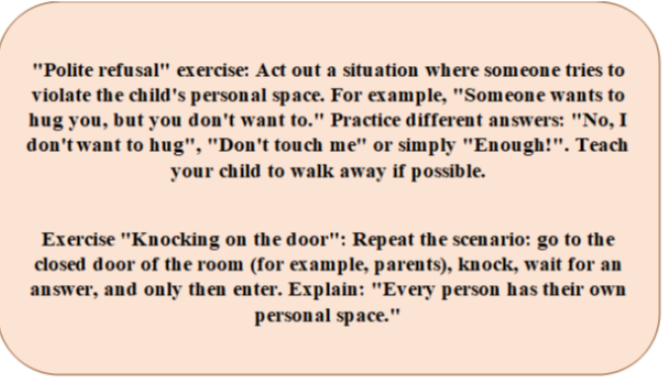
The Circles Concept: Instead of just explaining boundaries, use a diagram showing “safe zones” around a person to illustrate personal space.
Colour Coding: Use a “Traffic Light” system for physical contact: Green for safe/appropriate touch (e.g., high-fives, handshakes) and Red for private areas that should not be touched (by others).
Visual materials are not merely illustrations; they are essential tools for communication, social adaptation and self-regulation, helping the individual navigate a world that may otherwise seem unpredictable.
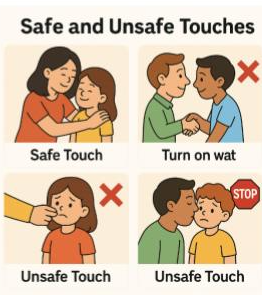
Comics: Create your own social comics depicting privacy-related situations. For example, how a child goes to the toilet, closes the door, and then leaves. This helps to visualise the sequence of actions and their social context.

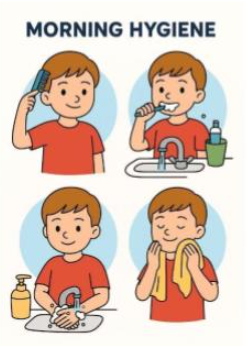
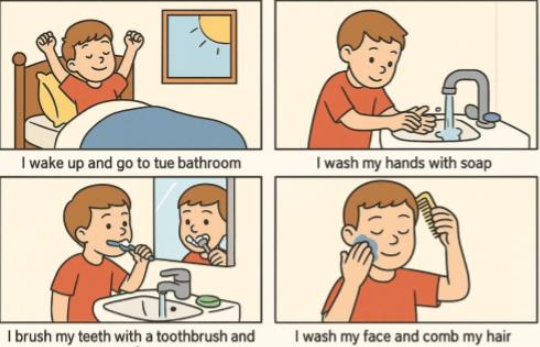
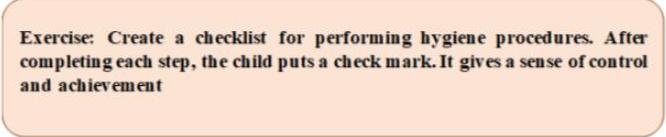
Visual schedules: Use schedules for hygiene procedures (for example, a daily schedule: “brush teeth”, “shower”, “put on clean underwear”). This makes the process predictable and reduces anxiety.
2. Social Stories
Social Stories are a powerful, evidence-based tool designed to help individuals on the autism spectrum (ASD) and those with neurodivergent profiles understand complex social nuances and behavioural expectations. Rather than merely listing rules, these stories provide a safe, predictable narrative that explains the What? How? and, most importantly, the Why? of specific social situations.
The effectiveness of Social Stories lies in their clear, consistent and person-centred structure. Each story focuses on a single, specific scenario, such as “Going to the Grocery Store,” “Asking to Join a Game,” or “Waiting for My Turn.”
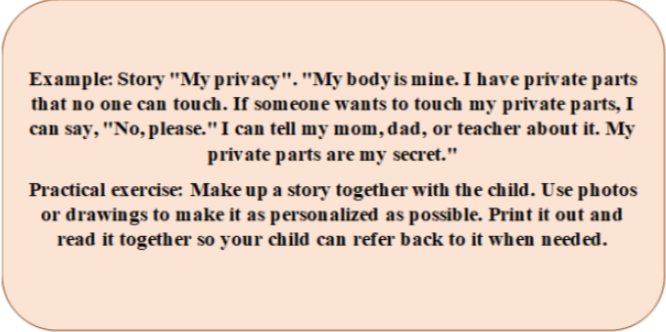
Social stories should be read regularly with the individual and are most effective when written in first-person language (e.g. “MY BODY IS MINE”). This allows the person to identify with the protagonist and internalise the message. Practitioners are encouraged to combine the text with clear visuals, symbols, or, where appropriate, the individual’s own photographs to support understanding.
When creating personalised stories, or Social Stories™ (the official term, protected by copyright), careful attention must be paid to the text and visual design. It is advised to use CAPITAL LETTERS, large, easy-to-read print and accessible fonts such as Arial or Calibri. Visuals should be simple, uncluttered and closely matched to the text to ensure clarity and reduce cognitive overload.
By utilising concise language, visual cues, and repetitive reinforcement, Social Stories empower the child to
- Understand Perspectives: gain insight into others’ thoughts, feelings, and expectations.
- Predict Outcomes – anticipate the sequence of events, which significantly reduces anxiety and sensory stress.
- Develop Coping Strategies – learn appropriate social responses and self-regulation techniques.
Ultimately, Social Stories transform the often-unpredictable world of social interaction into a series of manageable, logical steps. This builds the child’s confidence and fosters successful adaptation to various life environments, promoting independence and social inclusion.
3. Role-playing and modelling
For individuals with autism spectrum disorders (ASD), learning social skills can be complicated. Role-playing and modelling are practical tools that help you translate abstract social concepts into concrete actions. Experiencing various situations in a safe, controlled environment gives the child a stress-free opportunity to practice skills that are difficult to learn only theoretically. It can range from greeting to waiting one’s turn or resolving a conflict.
Modelling as a visual cue: This role-playing process becomes even more effective when used with modelling. It can be either a video recording of correct behaviour or a live example from an adult or another child. Individuals with ASD who are visual thinkers have an easier time absorbing information they can see. Modelling simplifies complex social scenarios into clear, step-by-step actions, making them much easier to follow. Thanks to this combination, the child not only remembers the rule, but also feels how it works in practice, which makes its adaptation to the social environment more successful and confident.
4. Clear, step-by-step trainin
Explicit, step-by-step instruction is a highly effective method based on the principles of Applied Behaviour Analysis (ABA). Its main idea is to break down complex skills or concepts into small, consistent, and easily digestible steps. This approach is helpful for learners with autism spectrum disorders (ASD) as it minimises the risk of information overload.
Advantages and applications: Instead of attempting to master a complex topic all at once, the child focuses on a single, manageable step. This incremental progression ensures early success, which is vital for building self-esteem and confidence. Only once a step is fully internalised does the educator introduce the next.
This method goes beyond rote memorisation; it ensures a deep, functional understanding of the material. Each new skill is built on a solid foundation of prior knowledge, providing stable, reliable progress.
Key components of this approach include:
- Visual Cues: using prompts to guide the child through each transition.
- Positive reinforcement: consistently rewarding progress to maintain motivation.
- Individualisation: tailoring the pace and complexity to the unique learning profile of each child.
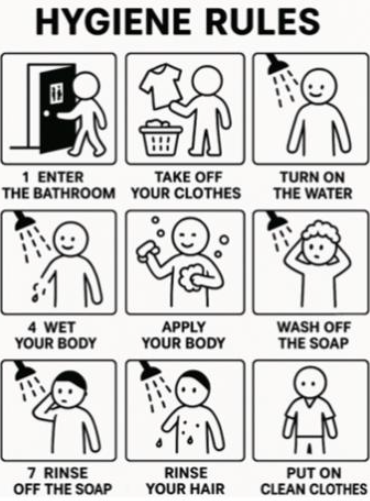
Example “Hygiene Rules”: Divide the process of taking a shower into separate steps: (1) Get into the bath, (2) Take off your clothes, (3) Turn on the water, (4) Wet your body, (5) Apply soap, (6) Wash off the soap, etc. A dedicated icon or pictogram should support each step.
5. Positive Reinforcement and the Token Economy
Positive Reinforcement is a cornerstone of motivation and skill acquisition. It operates on a straightforward principle: when a meaningful reward follows a desired behaviour, the likelihood of repeating that behaviour increases. Reinforcement must be highly individualised, aligning with each child’s specific interests and sensory preferences.
Forms of Reinforcement:
Social: Sincere praise, a smile, or a high-five (always respecting the child’s sensory boundaries regarding touch).
Activity-based: Access to a favourite game, a short video, or a preferred sensory activity.
Material: Stickers, a small toy, or a favourite treat.
To be effective, reinforcement should occur immediately following the desired action. This helps the child build a clear connection between their behaviour and the positive outcome, fostering self-esteem and a sense of agency.
The Token economy: For complex or multistep tasks, a token system is highly effective. The child earns tokens for specific actions (e.g., following a privacy rule or completing a hygiene routine). Once a predetermined number of tokens is collected, they are exchanged for a larger reward. This system makes abstract, long-term goals tangible and manageable.
6. Priming and Redirection
Priming (Proactive Preparation): Priming reduces anxiety by making new situations predictable. If a puberty session is approaching, begin preparing the child several days in advance: “In two days, we will look at how the body grows and changes.” Use visual schedules or short videos to familiarise them with the topic beforehand.
Redirection (Navigating Challenging Moments): If a child engages in socially inappropriate behaviour (e.g., touching private areas in public), it is vital to respond without shaming or punishment. Instead:
- Redirect Attention: Transition to a high-interest activity (“Let’s look at this book together”).
- Provide Clear Boundaries: Use neutral, factual language: “We only touch private parts when we are alone in the bathroom or bedroom.”
- Set a Framework: “We can talk about this more when we get home.” This reinforces the distinction between public and private spaces.
7. Prompting and Fading
The Prompting method guides a child from total support to complete independence through a “least-to-most” or “most-to-least” hierarchy.
- Physical Prompt: Guiding the child’s hand to apply the deodorant.
- Gestural Prompt: Pointing to the deodorant on the shelf.
- Verbal Prompt: Saying, “It’s time for deodorant.”
- Independent Action: The child completes the task without assistance.
The goal is Prompt Fading – gradually reducing help until the child achieves autonomy.
Conclusion: A Person-centred Approach
Education for learners on the autism spectrum must be individualised, consistent, and predictable. Every child is unique; an effective programme must leverage their strengths and interests while respecting their pace of development.
By combining visual schedules, clear instructions, and a supportive environment, we provide the child with a sense of safety and control. These methods, when used in harmony, create a foundation for lifelong confidence and social inclusion. Patience, empathy, and respect for the child’s dignity are the most vital tools in this process.
Core topics in sexuality education
● Body awareness, anatomical knowledge and interoception
What is body awareness, and why is it important?
Body awareness is the ability to recognise, understand, and interpret the sensations, movements, and boundaries of one’s own body.
Body awareness is a foundation for healthy sexuality education. Developing body awareness can support self-understanding, independence, safety and positive relationships. When someone learns to notice and name body parts, sensations, and personal boundaries, they are better equipped to communicate needs, recognise discomfort and protect themselves from harm. It also fosters self-confidence and respect for their own bodies, which are central to developing autonomy and consent in social and intimate situations. It includes
● Knowing the names and functions of body parts.
● Understanding the difference between public and private body parts.
● Recognising physical signals (e.g., hunger, pain, arousal, fatigue).
● Being aware of personal space and others’ physical boundaries.
● Understanding safe and appropriate touch in different contexts.
For autistic individuals, body awareness may not develop automatically. Differences in sensory processing, communication and social learning can make it harder to interpret body signals or to understand unspoken rules about touch and space.
How can I practice body awareness with autistic individuals?
Supporting body awareness requires a respectful, clear, and structured approach. Here are some strategies:
● Use concrete language and visuals:
-Teach body parts using clear and correct terms (e.g. “penis,” “vulva”) rather than vague or confusing words.
-Use pictures or social stories to illustrate concepts like private vs. public.
● Practice identifying sensations
-Encourage individuals to notice and name how their body feels (e.g. “My belly feels hungry”, “My shoulders feel tight”, “My chest feels tight”, “My heart feels warm”, “My tummy feels strange”).
-Use sensory check-ins, emotion thermometers, or visual scales to support recognition of internal states.
● Teach personal boundaries
– Model and role-play safe ways to ask for and decline touch.
– Use visual supports (like “stop” and “go” signs) to reinforce boundaries.
● Create structured opportunities for learning
– Use daily routines (e.g., dressing, bathing, mealtimes) as natural moments to discuss body parts and body care.
– Reinforce the distinction between private activities (like using the toilet or masturbation) and public activities.
● Respect individual differences
– Adapt teaching methods to the person’s sensory needs, communication style, and developmental level.
– Always prioritise dignity, consent, and the individual’s comfort.
By intentionally teaching body awareness, caregivers and professionals empower autistic individuals to develop self-knowledge, autonomy, and safer social connections. This lays the groundwork for healthy sexuality education that is inclusive, respectful, and protective.
What is interoception, and why is it important?
Interoception refers to the ability to perceive and process internal bodily signals, such as heartbeat awareness, hunger and fullness, thirst, temperature changes, physical manifestations of emotions, body cues, and other sensations. It represents a fundamental aspect of human consciousness and self-regulation. In ASD, differences in interoception can affect emotional regulation, social interactions and overall well-being (Neurofeedback Luxembourg, n.d.).
For individuals with ASD, interoceptive differences can also impact emotional processing, which is often linked to increased anxiety and alexithymia, a term that refers to difficulties in identifying and describing emotions. These differences can also influence empathy and perspective-taking, as it can be challenging to understand another person’s perspective when
one has difficulty interpreting one’s own embodied experience. (Neurofeedback Luxembourg, n.d.).
A growing body of research demonstrates that interoceptive awareness can be improved through practice. For example, Mahler et al. (2022) found that autistic children who practised identifying body signals and linking them to their emotions were better able to regulate their feelings afterwards. This finding highlights the importance of exercises that strengthen interoceptive awareness and accuracy (Neurodivergent Insights, n.d.).