TRAINING SERVICE PROVIDERS TO SUPPORT AUTISTIC INDIVIDUALS
Section 4.2: Activity suggestions on Private and public spaces, boundaries, consent and bodily autonomy
Goals:
This chapter aims to support learners with autism in:
● Understanding the concepts of private vs public (spaces, behaviours, body parts)
● Learning to recognise and assert personal boundaries
● Understanding and practising bodily autonomy and consent
● Building confidence to express themselves and seek help when needed
● Developing a sense of empowerment and self-protection
● Understanding and practising digital boundaries, including safe online behaviour and privacy awareness
Teaching Strategies
Visual Supports
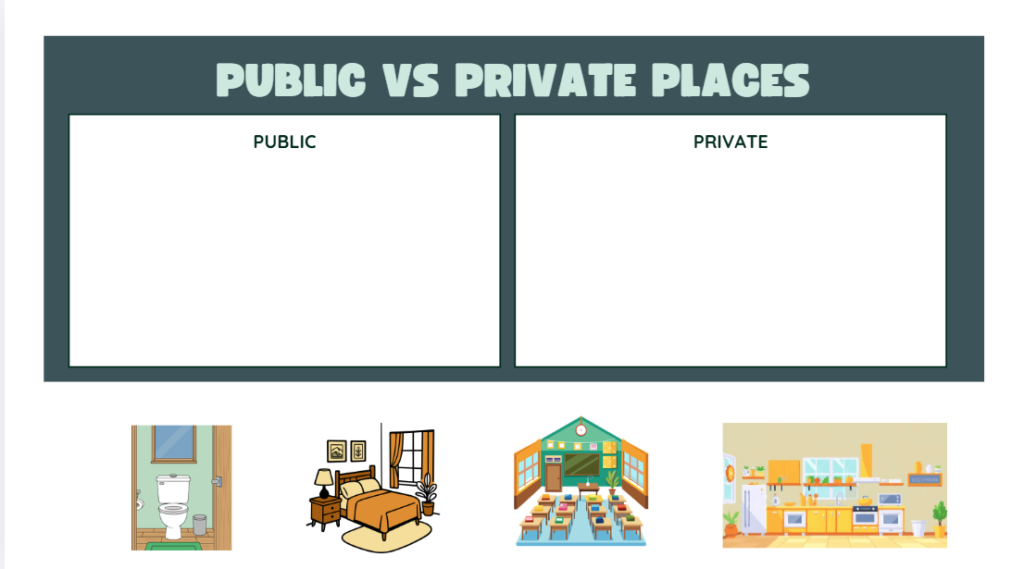
● Use visual cues to explain public vs private behaviour, places, and body parts (e.g., toilet = private, classroom = public)
● Display posters showing “safe touch vs unsafe touch” using age-appropriate visuals
● Create personal space visuals with zones (e.g., green = OK for friends, red = only for family or doctors)
● Use emotion charts to help learners express discomfort
Tip: Use colour-coded signs or stickers to reinforce zones of comfort (e.g., red = stop, yellow = check, green = go).
Social Stories
See page X for a more detailed description
– Suggested story topics:
● Saying No to Hugs
● Asking Before Touching Someone
● When It’s OK to Say Stop
● Safe vs Unsafe Secrets
● What is Public Online?
Role-Playing
See page X for a more detailed description
Some suggested scenarios to practice are:
● A peer wants to hug, but the child says, “No, thank you.”
● Someone stands too close, and the child says, “Please give me space.”
● The child asks, “Can I hold your hand?” and accepts a yes or no.
Tips:
● Use dolls or puppets for learners who are uncomfortable with direct role-play
● Offer clear, scripted responses (e.g., “I don’t like that,” “I need space,” “Can I sit here?”)
● Encourage repeated practice with slight variations to build confidence
Positive Reinforcement
Boundaries and consent can be emotionally complex topics. Positive reinforcement helps build self-esteem and encourages appropriate, respectful behaviour.
To achieve that:
● Offer praise for using assertive communication: “I love how you said ‘no’ clearly and kindly.”
● Use token systems or visual reward charts to motivate the practice of consent-related skills.
● Celebrate when the child recognises their right to say no or asks for help.
Modelling Behaviour
Learners with autism often learn best through concrete, observable examples. Modelling helps them internalise behaviours related to consent, boundaries, and autonomy.
Model the following behaviours:
● Asking: “May I sit next to you?”
● Saying: “No, thank you” or “I need space”
● Respecting when someone else says “no”
You can also use:
● Video modelling showing real individuals practising boundaries
● Daily modelling by adults and peers during school or therapy sessions
● Scripts and consistent routines that include boundary-respecting action
Optional Materials to Create:
● Personal Space Bubble Posters: Visual charts illustrating personal space zones with colour codes and simple explanations.
● Assertive Communication Cue Cards: Cards displaying common phrases like “Please stop,” “I need a break,” or “Can I have some space?” with icons or pictures.
● Consent Role-Play Scripts: Simple, scripted dialogues for practising asking for and giving consent in everyday situations.
● Safe vs Unsafe Scenario Cards: Illustrated cards depicting various social situations for sorting and discussion.
● Trusted Adults Chart: Personalised charts featuring photos or drawings of safe adults the child can approach for help.
● Empowerment Affirmation Posters: Positive message posters featuring statements such as “My body belongs to me” and “I have the right to say no.”
● Digital Boundaries Sorting Cards: Cards illustrating safe vs unsafe online behaviours, information sharing, and respectful communication.
● Visual Social Stories Booklets: Laminated or printable social stories covering topics like personal boundaries, consent, and digital safety.
● Help-Seeking Cue Cards: Cards that guide learners through steps to seek help, including identifying trusted adults and using simple phrases.
● Interactive “What Would You Do?” Game: A set of illustrated scenarios prompting learners to choose appropriate responses related to boundaries and consent.
– Social Story Reading
Read stories on topics like personal space, consent, or safe touch. Use books like “My Body Belongs to Me” or custom-made social stories.
➡ Pause to ask questions like:
● “What part of the story showed good boundaries?”
● “What should the child do next?”
– Digital Boundaries Sorting Game
Use printed or digital cards showing online actions (e.g., sharing a name, sending a photo, using kind words).
➡ learners sort them into “OK to share” and “Not OK to share.”
➡ Reinforce safety rules: “If it feels private, don’t post it.”
– Online Safety Circle
Draw two circles on a poster or board: “Safe Online” and “Not Safe Online.” Ask learners to place cards or stickers with examples into the correct circle.
➡ Discuss why certain information (e.g., address, full name) should be kept private.
– Interactive “What Would You Do?” Game
Present illustrated social scenarios involving personal space, touch, or digital interactions. Ask learners to discuss or select what they would do in each scenario from multiple-choice options. Use group discussion or role-play to explore the consequences of each choice.